Farmer guide · buying cattle
Buying a dairy heifer: what to check before you pay
A good heifer pays you back for years; a poor one costs you feed and vet bills before she gives a litre. Here's how to choose well, from a farm that sells them.
Pick the stage that suits you
The younger she is, the less you pay and the longer you wait for milk. You also carry the risk of rearing her and getting her in calf. KALRO puts a Friesian's first service at 15 to 18 months and her first calving at 24 to 32 months.
- Weaned calf: cheapest, but about a year of feeding before her first service, and nine months more before she calves.
- Bulling heifer: ready for her first service. You choose the bull or AI semen, so you choose her calf's line.
- In-calf heifer: the service is done and confirmed. Milk starts when she calves, and the calving date is known.
- First-calf heifer with calf: costs the most, but milks from the day she arrives and you can see her yield.
If this is your first cow, an in-calf heifer is usually the safest start: the hardest part, getting her in calf, is behind her.
Check her with your own eyes
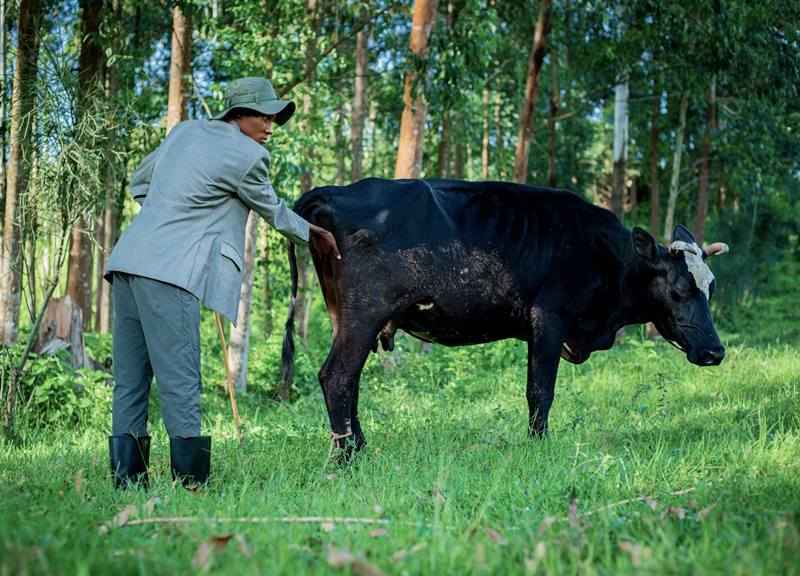
Always see her before you pay, standing and walking, in daylight. If you can, bring a vet or an experienced farmer.
- Alert and bright: clear eyes, a moist, clean nose, ears up, and she eats and chews the cud normally.
- Right condition: the last ribs just visible, with flesh over the hips and backbone. Neither bony nor fat. KALRO advises a body condition score of 3 to 3.5 (on a 1 to 5 scale) at first service.
- Big enough, not just old enough: KALRO advises serving her once she reaches about 60% of her expected adult weight, usually at 14 to 18 months. A small heifer at 18 months has been underfed, and that can hold back her milk later.
- Sound legs and feet: she walks freely with no limp, and her hooves are even and not overgrown.
- Smooth coat and skin: no patches, lumps, sores or heavy ticks, especially in the ears, under the tail and around the udder.
- Four teats, evenly placed: no hard or swollen quarters. On a heifer in milk, ask to see her milked.
Ask for her records
A heifer without records is a guess. Ask to see, in writing:
- Her birth date and dam: and her dam's milk record if there is one. It's the best clue to what she'll give.
- For an in-calf heifer: the service date, the bull or AI semen used, and a vet's pregnancy check. Calving is about nine months (around 283 days) after service.
- Deworming and treatments: any illness, what she was given and when. A seller who keeps records will have nothing to hide.
- Her vaccination card, signed by a vet. You'll need it for her movement permit too. Check it against the usual Kenyan routine below.
| Vaccine | How often | Notes |
|---|---|---|
| Foot-and-mouth disease | Every 6 months | Where the disease is common, as it is across much of Kenya. Counties also vaccinate in outbreaks. |
| Anthrax and blackquarter | Every year | Usually one combined jab, first given at about 6 months old. |
| Lumpy skin disease | As your county vet advises | Usually when the disease threatens, often in county campaigns. |
| Brucellosis | Once in her life | For heifer calves aged 3 to 8 months only, given by a vet. A heifer bought older should already have it on her card. |
| East Coast fever | Once (ITM) | Optional but valuable where brown ear ticks are common. Only a trained vaccinator can give it; ask your county vet. |
The right schedule depends on your area, so confirm it with your county or sub-county veterinary officer.
Get your farm ready first
- A dry, shaded shed with a firm floor that drains, a feed trough and room to lie down.
- Clean water all day. A cow in milk drinks 40 to 60 litres a day, and up to twice that in hot weather.
- Feed lined up: enough fodder (Napier, Rhodes or hay) for weeks, not days, plus a mineral lick. Add dairy meal in late pregnancy and once she's milking.
- Tick control on a regular spray or dip routine, and a local vet or AI service you can call.
Bring her home legally and safely
- Get a movement permit before she travels. Under the Animal Diseases Rules, cattle can't be moved between areas without one. Apply to the veterinary office where she is now; it checks her health and vaccination card.
- Ask whether there's a quarantine at either end. During outbreaks such as foot-and-mouth, counties stop or restrict movement, and the vet at the destination may need to agree first.
- Use a vehicle with high sides and a non-slip floor (sand or grass on the bed), and travel in the cool of the day with the permit on board.
- Drive gently, especially with a heifer that's heavy in calf.
- At home, give her water and fodder and let her settle. Change her feed gradually over a week or two.
What comes with a heifer from our farm
Every heifer we sell has her record from our farm records system, and you see her before you buy.
| Stage | She comes with |
|---|---|
| Weaned heifer calf | Her dam's milk record, vaccinations and deworming |
| Bulling heifer | Vaccinations, deworming and her growth record |
| In-calf heifer, early | Service date, the bull or semen used, the vet's pregnancy check |
| In-calf heifer, late | Service date, the bull or semen used, the vet's pregnancy check and her calving date |
| First-calf heifer with calf | Her calving, her first milk yields, the calf's record |
Where this information comes from
Checked against these sources. Rules and schedules change, so confirm with the relevant office before you rely on them.
- KALRO: Livestock breeds training module (Friesian first service and calving ages)
- Kenya Law: The Animal Diseases Rules (movement permits)
- KALRO Dairy Research Institute: Rear your own heifers (pamphlet 036/2024: service weight and body condition)
- The Standard: common diseases affecting dairy cattle (foot-and-mouth every six months)
- MSD Animal Health: Blanthrax (anthrax and blackquarter, from 6 months, yearly)
- Journal of the South African Veterinary Association: S19 brucellosis vaccine for heifers aged 3 to 8 months (WOAH advice)
- Kenya News Agency: county lumpy skin disease vaccination
- ILRI: the East Coast fever vaccine (ITM)
- Nation, Seeds of Gold: how much water dairy cows need
Come and see our heifers
Tell us the stage you want and when you can come to the farm in Kirindo, Siaya. You see her and her records before you pay.